
 Sở Bảo Tồn và Giải Trí
 Bảo Tồn. Bảo Vệ. Tận Hưởng.
Sở Bảo Tồn và Giải Trí 


Profitable farms create healthier watersheds. In this interview, Bob Waring of Brandon Farms and Virginia Tech Agronomist Dr. Hunter Frame discuss water management challenges on Brandon Farms, maximizing per acre profit, nutrient use efficiency, regenerative agriculture, best management practices and cost-share programs that benefit Virginia’s farms.
Read excerpts from the interview below.
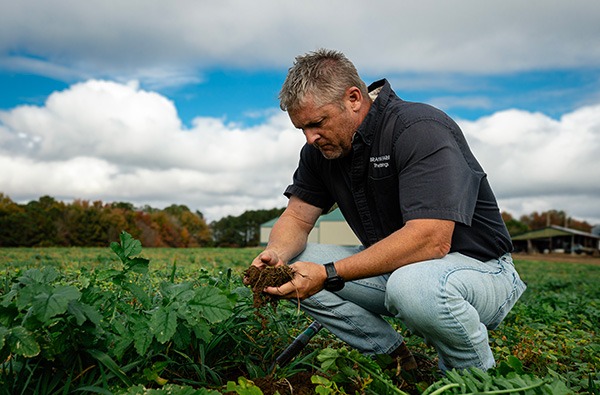
Bob Waring:
I think one of the big issues we’re going to have over the next decade is water management — water and heat management. In the work you all are doing, I think you’ll agree that managing water, in one way or another, determines what yields will look like in the future.
Then the question becomes: How do we use cover crops to manage that water? Economics is also going to be huge over the next decade. How do we become a profitable, sustainable farm for the future? A lot of that comes down to how we manage our inputs (essential supplies for agricultural production, including seeds, fertilizers, pesticides, fuel and machinery) and how we manage nutrients going forward. That’s the way I look at things.
Hunter Frame:
Yeah, I agree. When I first started working with cover cropping systems in cotton production, the first thing I focused on was: How can this be profitable from day one for Virginia producers?
As we’ve moved into corn systems, I’ve kept that same mindset — this has to pay for itself starting day one. I know this state has some very aggressive and progressive cost-share programs for different cover crops, but as we look at the climate moving forward, profitability and return on investment are going to be huge for Virginia producers.
Over time, you start to see some of the environmental benefits of cover crops take over — in terms of sustainability and resilience — when we’re dealing with environmental challenges like sporadic heavy rainfall events or extreme weather events.
Now it seems like we get rain in 3- to 5-inch increments, instead of an inch spread out over a week. Whether you call that climate change or something else, we’re seeing those weather patterns. We’re also seeing more intense drought periods. Cover crops have a role in limiting those impacts in our agricultural environment.
Waring:
That’s exactly what I mean by managing water. If you don’t have irrigation, you have to manage water through cover crops.
In the spring of 2024, that was a humbling year for us here on this farm — one of the driest years we’ve had in what I’d say in our history here. Even so, we were still averaging 20–30% above the state average, which was 114 bushels per acre for corn.
Most farmers, from what I understand, put somewhere between $600 and $700 per acre into those corn crops. At $4 corn, you’re looking at about 150 bushels per acre just to break even.
On this farm, we were somewhere around $350 per acre in cost, which meant our break-even was about 89 bushels per acre. So even in one of the worst years we’ve ever had, we were still able to sustain profitability on the farm, largely because of cover crops.
Waring:
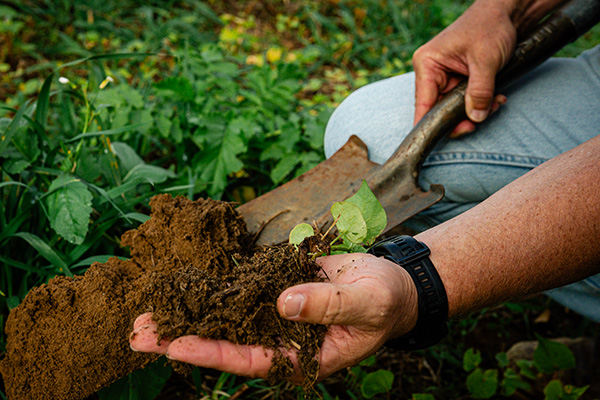
When we talk about regenerative agriculture — versus organic farming or traditional systems — I think of it simply as regenerating the soil.
That’s really what this grant out here is about. It’s an American Farmland Trust Healthy Soils grant. The core question is: Can I change the soil? Can I affect soil biology, organic carbon, organic matter, phosphorus, potassium?
What happens if we give the soil essentially a “year off” to rest and rebalance? For me, regenerative ag is about bringing the soil back into balance and letting it produce what we need, rather than relying solely on synthetic inputs that may not align with what we’re trying to accomplish.
Frame:
I love that idea — being able to be regenerative. “Sustainable” used to be the big buzzword in academia about ten years ago; now we’re hearing more about regenerative systems.
Any time we grow a crop and remove it from a field — whether it’s grain or specialty crops — we’re removing nutrients. Soils can mineralize and supply some nutrients, but there’s always going to be a need to put back what we remove.
Legumes offer a great alternative to some synthetic nitrogen fertilizers because they fix nitrogen from the atmosphere. But we still remove potash (potassium) and phosphorus with harvested crops.
In a regenerative framework, I think we can rebuild soil chemical and physical properties, but it may take years or decades to get back to where they were before intensive tillage and continuous cropping. For the last 40 years, Virginia has done a lot with no-till and nutrient management plans, and I think we’re starting to see some rebuilding, especially in the Coastal Plain.
From an academic standpoint, I don’t think we’ll completely eliminate fertilizers — we still need to replace what we remove. But we can do a much better job recycling nutrients.
In our research, legume covers can take up 300 pounds of K2O per acre from the subsoil and redeposit it near the surface. They’re not creating new potassium; they’re just limiting deep losses and making more of it available near the root zone.
They also form symbiotic relationships with bacteria to fix atmospheric nitrogen, turning it into a biologically available fertilizer form.
So, my goal is to get to where we’re recycling a much higher percentage of nutrients than we have historically. That’s where regenerative practices really shine.
Waring:
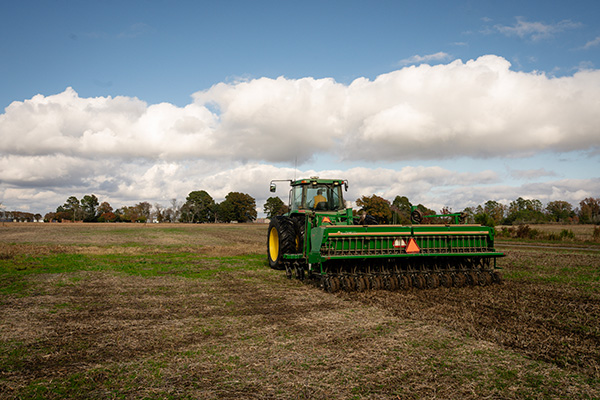
We’re part of the Virginia cost-share program and are enrolled in the Whole Farm Approach, which was developed four or five years ago. The idea is to capture everything we’re doing on the farm — multiple side-dressings, top-dressings, legumes, rye cover, etc. — and get all of that data into the watershed model.
We’ve been utilizing cost-share programs for the last eight to ten years. Cost-share is intended to help producers try a different system by reducing the financial burden of buying seed or precision equipment and taking on the risk of a new practice.
The cost-share helps us purchase what we need, try the system, and then figure out as producers how to make it work and become viable in the long term.
Director:
How difficult was it for you to jump into the Whole Farm Approach?
Waring:
It was actually very simple for me — partly because I was one of the folks who helped create it.
I remember sitting in my office one day after getting approved for cost-share on only half of my cover crop acres. I appreciated the support, but I wondered, “How do I get credit for the rest of my cover crop? What about my side-dress applications? My starter fertilizer?”
A light bulb went off. I approached my manager at the district, and we talked with other district managers about whether a Whole Farm system would work for them. From there we went to leadership at DCR and got approval for a pilot in Three Rivers Soil and Water Conservation District.
The pilot went really well. We gathered a tremendous amount of data. Since then, DCR has been expanding it, and now I think roughly a dozen districts are using a version of the Whole Farm Approach.
I honestly think the entire Chesapeake Bay watershed could benefit from something similar. The amount of data coming out of that program is huge when it comes to documenting what farmers are actually doing — because we know many are already implementing BMPs. We just needed a way to count and document them properly.
Contact your local Soil and Water Conservation District today and learn more about Virginia’s cost-share program and implementing best management on your farm at dcr.virginia.gov/costshare.
Hạng mục
Bảo tồn đất và nước


