
 Sở Bảo Tồn và Giải Trí
 Bảo Tồn. Bảo Vệ. Tận Hưởng.
Sở Bảo Tồn và Giải Trí 


Due to the expected impact of the winter storm, all Virginia State Park overnight facilities will be closed from Friday, Jan. 23 through Tuesday, Jan. 27. This decision is based on the forecast for unsafe conditions and potential power outages. For updates click here.
Written by Molly Kirk, Virginia Department of Wildlife Resources
The image of a group of white-tailed deer chewing contentedly on lush foliage makes for great photos, but when those deer are on a Natural Area Preserve (NAP), it’s not as pretty a picture. “Most people don’t realize, until you really watch deer, just how much one deer can actually eat when they’re walking through a forest or an open meadow,” said Tyler Urgo, Regional Supervisor of the Shenandoah Valley Region with the Virginia Department of Conservation and Recreation (DCR).
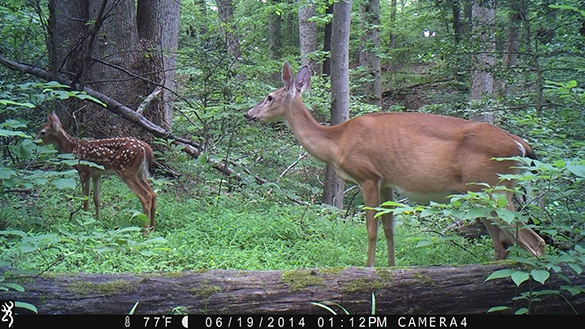
Browsing deer can do quite a bit of damage to both imperiled and common plants on a Natural Area Preserve.
On the average, deer eat between 4 and 8 pounds of green foliage a day. Put a herd of 15 deer on a piece of property, and those pounds add up to a lot of plants ingested. The problem is, NAPs are specifically intended to be refuges for rare and imperiled plants and animals. They’re officially designated as an area “important in preserving rare or vanishing flora, fauna, native ecological systems, geological, natural historical, scenic or similar features of scientific or educational value benefiting the citizens of the Commonwealth.”
By design, NAPs are often home to native and imperiled plant species. The problem is, deer don’t recognize when they’ve wandered into a NAP. They just eat what they like wherever they find it. Because deer especially favor native plants, deer populations that have grown too large can quickly over-browse these areas, stripping away both imperiled and more common native species and doing significant damage to many Virginia NAPs.
Michael Lott, Regional Supervisor of the Northern Region with DCR, has noticed it at Crow’s Nest NAP. “With deer browse at a more normal level, glade fern (Homalosorus pycnocarpos) is probably going to be 40 to 50 percent of the herbaceous plant cover,” Lott said. “But now in certain places, it’s like less than 10 percent of the cover. It’s just more or less browsed to the ground. And we see similar things with tall bellflower (Campanula americana). About a decade ago, there was a really small acorn crop and a very cold winter, and deer numbers dropped significantly for a few years. The tall bellflower at Crow’s Nest was six feet tall and blooming. Over the years since then, it’s back down to six inches because of the browse pressure.”
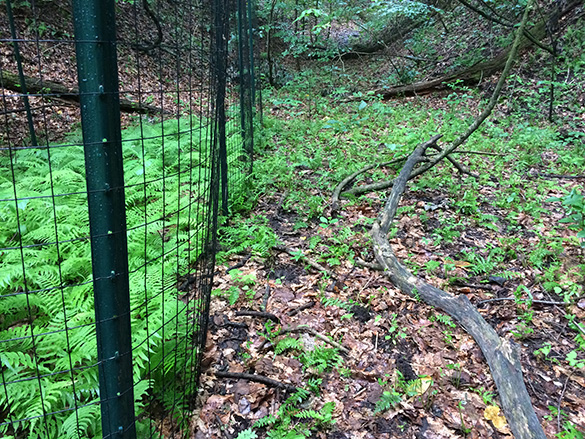
Glade fern behind a fence (left) showing normal growth after protection from deer, with over-browsed glade fern on the right.
White-tailed deer are an iconic part of Virginia’s landscapes, but in the early 1900s, they were nearly wiped out by over-harvest. Work by the agency now known as the Virginia Department of Wildlife Resources (DWR) helped restore the deer populations to healthy numbers, and now some areas of the state are even over-populated. “Most of us in Virginia have just gotten used to what it looks like with too many deer on the landscape,” said Urgo. “In most of Virginia, we see a pretty intense amount of browse, and our forests would be completely different with much less volume of that browsing pressure.”
For a problem involving plants and deer, the state agencies tasked with managing those resources have joined forces. DCR and DWR are working together on a Natural Area Preserve Deer Management Program that’s a science-based, long-term solution to reduce ecological damage caused by overabundant deer. By providing unique, conservation-driven hunting opportunities, this program will also reduce the amount of deer browse pressure on NAPs.
“On Virginia’s Natural Area Preserves, hunting is not just recreation—it’s a vital conservation tool,” said Max Goldman, NAP Deer Management Program lead and statewide access coordinator for DWR. “What’s exciting about this program is that it not only helps us take care of these special places, but also creates real opportunities for hunters—whether it’s someone just getting started through our Mentored Hunting and Hunter Education Programs, or veterans and active-duty service members finding connection in the outdoors. It’s conservation in action, led by hunters.” The venison resulting from the hunts will also benefit the wider community by being donated to food banks through the Hunters for the Hungry organization.
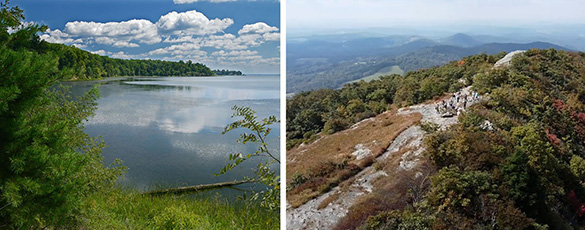
DWR and DCR representatives have created the NAP Deer Management Plan to help preserve the resources at Natural Area Preserves like Crow’s Nest NAP (left) and Buffalo Mountain NAP (right) across the state.
Urgo recalled planting 1,000 shortleaf pine trees (Pinus echinata) at an NAP on the western side of the state as part of a restoration project. “That winter, the deer ate the tops out of 90 percent or better on those trees. The deer are flocking to us and really putting a lot of pressure on our ability to regenerate these trees,” he said. “Our hope is that by applying a certain amount of hunting pressure there and harvesting a certain number of deer, we can see a reduction in some of the browse pressure on the things we want to grow.”
Urgo noted that restoring the ecology of the NAPs to a more natural balance will benefit all plant and wildlife species. “By eliminating some of the deer, we’re allowing certain plants to grow that are then going to support a whole host of insect species all the way through bird species, all the way up to mammals,” he said. “We’re trying to help protect the base levels of the food chain and have the most diversity there so that they can support levels on and up through the chain.”
The Natural Area Preserve Deer Management Program is a unique opportunity for DCR and DWR to work together to preserve natural resources, provide Virginians with meaningful hunting opportunities, and help feed in-need families. For the 2025-26 fall and winter, eight NAPs across the state have been identified as locations for deer management. As DCR and DWR evaluate the success of the program, other NAPs may be added in the future.
Hạng mục
Bảo Tồn | Cây bản địa


